Phonics Curriculum Implementation
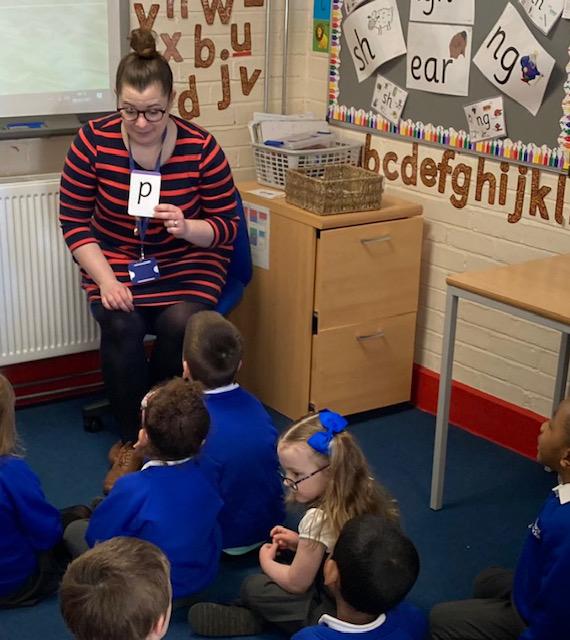
Pupils at Beecroft begin learning phonics from when they enter the school in EYFS and through Key Stage 1. We follow Essential Letters and Sounds in both EYFS and KS1. The children are taught in their classes for their daily phonics sessions. Phonics interventions are implemented with identified children who may require additional support.
Phonics Screening - guidance for families
The Phonics Screening Check (or Phonics Screening Test) is a test to assess and show how well a pupil can use and apply the phonics skills that they’ve learnt up to the end of Year 1. It takes place every year. The Phonics Screening Check is also an opportunity for teachers to identify pupils who need help with their phonics as they go into Year 2 and beyond.
In simple terms, a Phonics Screening Check is designed to check whether pupils have a good understanding of what they have learnt in phonics so far.
Every pupil in Year 1 in England has to take the Phonics Screening Check. The pupil takes the test during a one-to-one sitting with their class teacher.
How does the Phonics Screening Check work?
The Phonics Screening Check is defined by the DfE as 'short, light-touch assessments'. During the Phonics Screening Check, pupils are asked to read (decode) 40 words. Most of these words are real words, but some are also pseudo-words. A pseudo-word is a fake word that features strings of letters that resemble real words.
The test is divided into two sections. In section one, pupils are asked to recognise simple word structures and grapheme-phoneme correspondences (GPCs) from the earlier phases of the phonics curriculum.
Section two of the Phonics Screening Check is more difficult. Here, pupils need to recognise GPCs from later stages of the phonics curriculum. They will also be exposed to graphemes that correspond to more than one phoneme and they will need to decode them.
There isn’t a time limit for the Phonics Screening Check, but it usually takes around eight to ten minutes.
If a pupil does not pass and does not meet the expected standard, they will be given the appropriate support with their phonics to help them eventually reach the expected standard. They will then re-take the Phonics Screening Check the following year.
Sound Pronunication
Please use these Essential Letters and Sounds videos to help your child with the correct pronunication of the sounds they are learning.

|
Phonics Screening Check PPT for Year 1 Parents | [pdf 610KB] |

|
|
|
EYFS Phonics Workshop Parents Information | [pdf 197KB] |
|
|
|
EYFS Phonics Workshop Presentation | [pdf 535KB] |
|
|
|
Phonics Vision Statement | [pdf 113KB] |
|
|
|
ELS Term by Term Progression Grid | [pdf 294KB] |
|
|
|
Grapheme Sheet Phase 5 for parents | [pdf 12MB] |
|
|
|
Grapheme Sheet Phase 3 for parents | [pdf 5MB] |
|
|
|
Grapheme Sheet Phase 2 for parents | [pdf 3MB] |
|

|
Phase 5 pronunication | [mp4 13MB] |
|
|
|
Phase 3 pronunciation | [mp4 20MB] |
|
|
|
Phase 2 pronunication | [mp4 13MB] |
|